
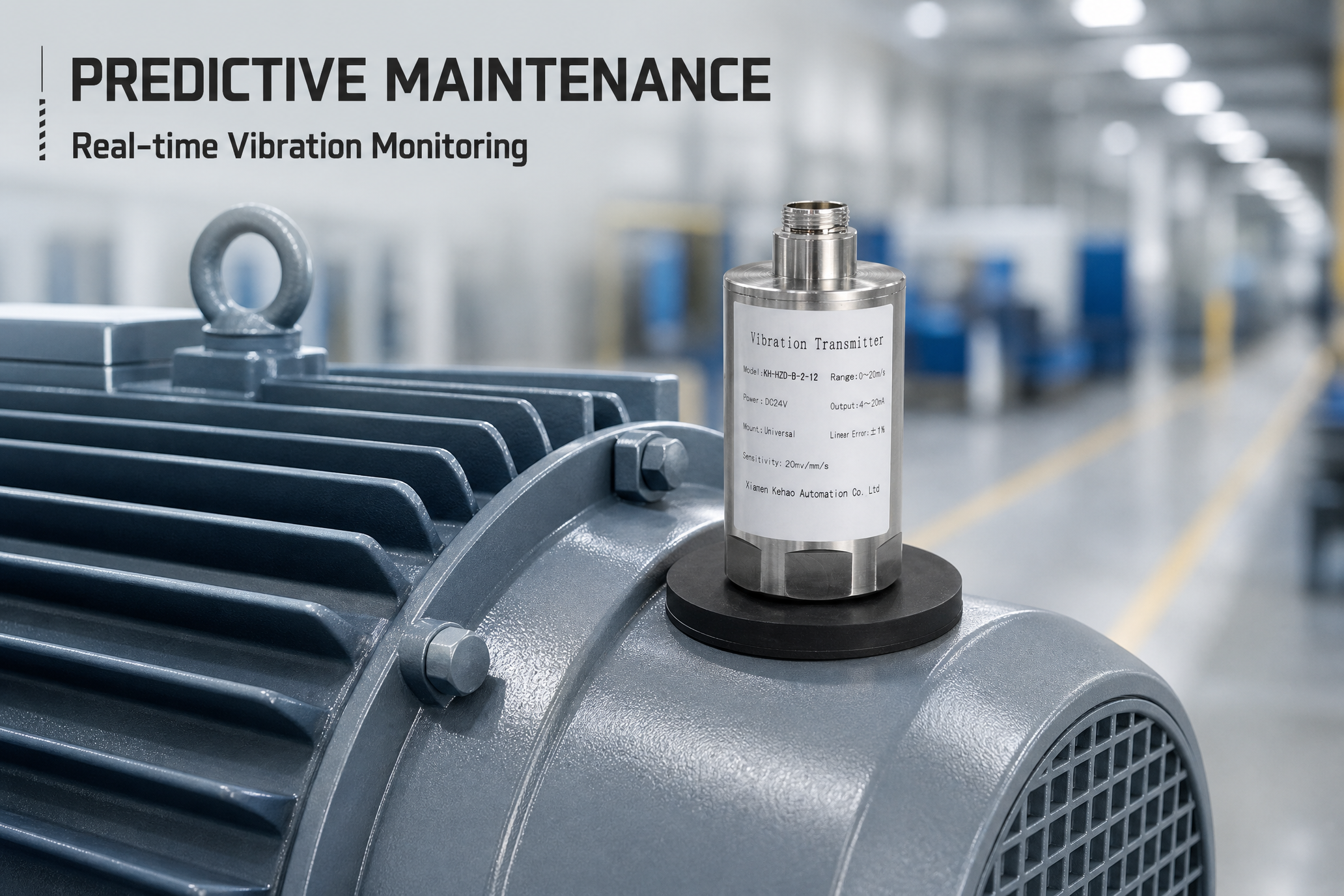
Industrial Vibration Sensors Selection Guide for Predictive Maintenance in Industry 4.0
Unplanned downtime acts as a silent profit killer for manufacturers in the Industry 4.0 era. Industry research reveals that Predictive Maintenance (PdM) cuts maintenance costs by up to 30% and reduces equipment failures by 70%. Industrial vibration sensors stand at the core of this maintenance strategy.
For engineers, selecting the right sensor guarantees data integrity for complex FFT analysis. For procurement managers, the priority is balancing long-term reliability and total cost of ownership. This guide covers both technical and commercial insights to support your sensor selection.
1. Understand Core Sensor Technologies
Not all vibration sensors are created equal. Sensing elements deliver vastly different results depending on your use case, whether you are monitoring high-speed spindles or low-speed cooling fans.
Piezoelectric (IEPE) Sensors: The Industrial Standard
Piezoelectric accelerometers are the workhorse for industrial condition monitoring. These sensors leverage the piezoelectric effect to generate an electric charge proportional to acceleration.
Why engineers prefer them: They feature a wide dynamic range and robust construction, capable of operating in harsh environments at temperatures up to 150°C.
IEPE Standard: Most modern piezoelectric sensors adopt the IEPE (Integrated Electronics Piezo-Electric) standard, enabling long-distance signal transmission with minimal noise interference.
MEMS Sensors: The Future of IoT Monitoring
Micro-Electro-Mechanical Systems (MEMS) integrate sensing and electronic components onto a single chip, transforming the vibration sensor market.
Key benefits: Low power consumption and compact form factor make MEMS ideal for wireless IoT vibration sensors. DC Response: Unlike piezoelectric sensors, MEMS devices can measure frequencies down to 0 Hz, which is critical for structural monitoring and low-speed tilt applications.
2. Key Selection Criteria for Engineers
When reviewing datasheets, focus on these four technical specifications to match the sensor to your equipment’s vibration characteristics:
- Frequency Response (Bandwidth): Confirm the sensor’s measurement range covers your machine’s operating speed and potential harmonic frequencies. A minimum bandwidth of 10 kHz is required for high-speed gearboxes.
- Sensitivity: Measured in mV/g. Higher sensitivity (e.g., 500 mV/g) suits low-amplitude vibration, while 100 mV/g serves as the standard sensitivity for general industrial applications.
- Signal Output:
- 4-20mA output: Optimized for direct PLC integration without complex data acquisition hardware.
- Raw dynamic data: Essential for advanced diagnostic analysis and FFT processing.
- Environmental Protection: For corrosive or washdown environments, choose sensors with IP67 / IP68 ratings and 316L stainless steel housings.
3. Procurement Perspective: Maximize ROI
From a procurement manager’s standpoint, the lowest-cost sensors often become the most expensive over time due to high failure rates or false alarms.
- Standardization: Sensors with 4-20mA vibration transmitters simplify supply chain management and work seamlessly with standard industrial controllers.
- Scalability: Wireless Bluetooth or LoRaWAN vibration sensors reduce installation costs; wiring typically accounts for 60% of traditional monitoring system expenses.
- Supplier Credibility: Verify that manufacturers provide individual calibration certificates traceable to NIST to ensure consistent accuracy across hundreds of units.
Pro Tip: If your facility operates hundreds of identical motors, pilot an IoT monitoring system first to validate ROI before full-scale rollout.
FAQ
What is the difference between vibration sensors and accelerometers?
Technically, an accelerometer is a type of vibration sensor. “Vibration sensor” is a general term, while “accelerometer” specifically refers to sensors that measure the rate of change in velocity. The two terms are commonly used interchangeably in industrial Predictive Maintenance (PdM).
How to integrate vibration sensors into existing PLC systems?
Vibration transmitters with 4-20mA output offer the most straightforward integration method. The PLC reads vibration levels as analog signals and triggers alerts when readings exceed thresholds defined by ISO 10816.
Why is triaxial monitoring superior to single-axis monitoring?
Machines rarely vibrate along only one axis. Triaxial vibration sensors capture data simultaneously across X, Y and Z planes, delivering a complete view of shaft misalignment, imbalance and bearing wear that single-axis sensors may miss.
Conclusion
Selecting the right industrial vibration sensor requires collaboration between engineering precision and procurement strategy. By prioritizing frequency range, output type and environmental durability, you can build a robust monitoring system and achieve cost savings through reduced downtime.
Post time: 2026-09-11