
I. What is Response Time and Why Does It Matter?
In engineering, the response time of a temperature sensor (often denoted by the thermal time constant $\tau$) is defined as the time required for the sensor’s output to reach 63.2% of a step change in temperature. In practical applications, we often focus on $T_{90}$ (the time to reach 90% of the change), which is approximately $5\tau$ and represents the point where the sensor has essentially completed its response.
A fast response time delivers:
-
Higher Control Precision: In temperature control systems, rapid feedback prevents temperature overshoot or oscillation.
-
True Data Capture: It allows for the recording of instantaneous temperature fluctuations, which is critical for scientific research and fault diagnosis.
-
Increased Efficiency: In production processes, faster measurement can shorten cycles and boost throughput.
II. Comparison of the Three Main Temperature Sensors
Due to inherent differences in physical principles and construction, response speeds across sensor types can differ by orders of magnitude.
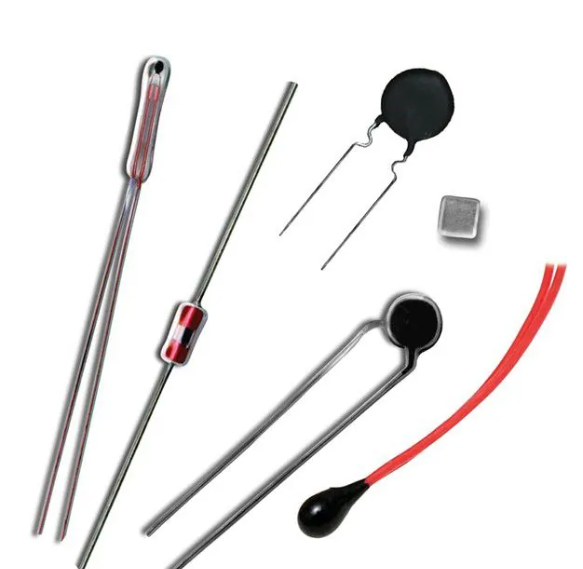
1. Thermistors: The “Sprint Champions” of Speed
-
Principle: Utilizes the characteristic of semiconductor/ceramic materials where resistance changes exponentially with temperature.
-
Specific Response Times:
-
Glass-encapsulated Micro-bead NTC: Due to extremely low thermal mass (as small as 0.1mm), the $\tau$ value can be as low as 0.1 – 1 second in stirred water, with $T_{90}$ reaching 0.5 – 5 seconds.
-
Chip or Coated Thermistors: Slightly slower, but $\tau$ values typically remain within the 1 – 10 second range.
-
-
Summary: Extremely fast, compact, and highly sensitive, but with a narrower temperature range (typically -50°C to 300°C) and lower long-term stability.
-
Typical Applications: Medical thermometers, automotive water/air sensors, mobile battery monitoring, and home appliances.
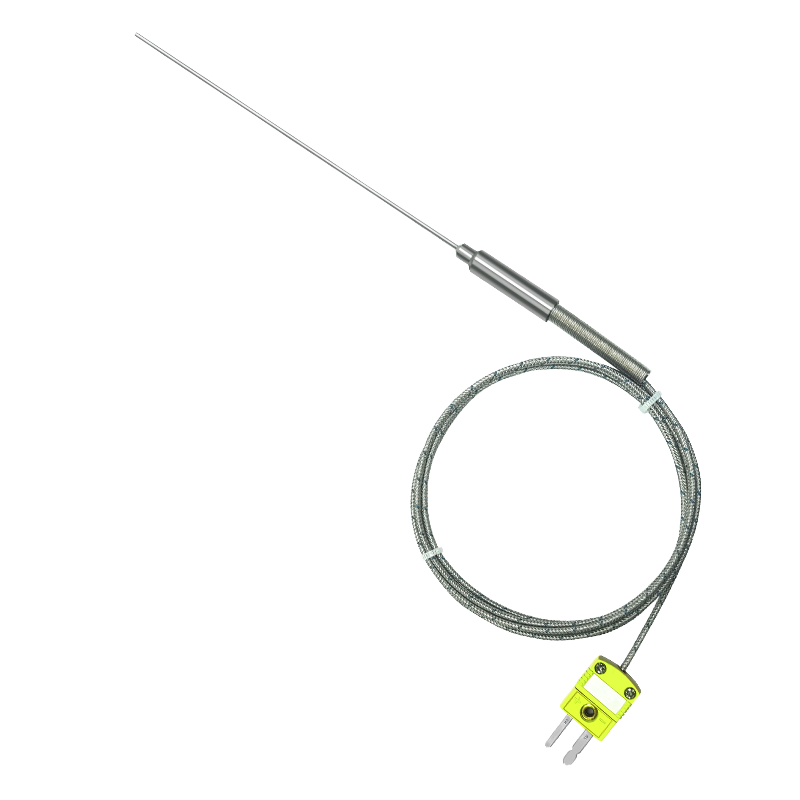
2. Thermocouples: The “All-Rounders” Balancing Heat and Speed
-
Principle: Based on the Seebeck effect at the junction of two dissimilar metals.
-
Specific Response Times: Highly dependent on the junction and packaging type.
-
Exposed Junction: The junction is directly exposed to the environment with no protection. In air, the $\tau$ value can be 0.1 – 1 second, comparable to micro-thermistors. This is the fastest thermocouple configuration.
-
Grounded Sheathed: The junction is welded to the metal sheath, providing a short heat conduction path. In stirred water, a 1.0mm diameter sheathed thermocouple has a $\tau$ of approx. 0.2 – 0.5 seconds; in air, it is approx. 1 – 3 seconds.
-
Ungrounded (Insulated) Sheathed: An insulation layer sits between the junction and sheath, increasing thermal resistance. For a 1.0mm diameter, the $\tau$ is approx. 0.4 – 0.8 seconds in water and 3 – 8 seconds in air.
-
-
Summary: Extremely wide temperature range (up to 1800°C), rugged, and adjustable response speeds (by choosing different sheath diameters and junction types).
-
Typical Applications: Engine exhaust, boiler temperatures, and injection molding nozzles.
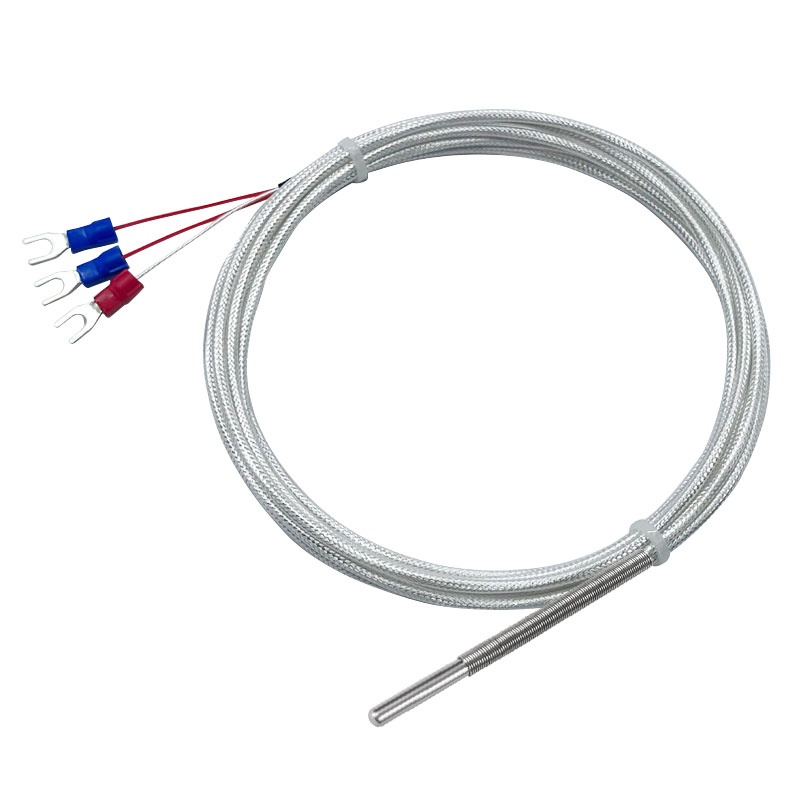
3. RTDs (Resistance Temperature Detectors): The Precise “Marathon Runners”
-
Principle: Utilizes the stable, linear change in resistance of high-purity metals like Platinum (Pt) relative to temperature.
-
Specific Response Times:
-
Industrial RTDs (e.g., Pt100) are usually housed in metal sheaths with Magnesium Oxide (MgO) insulation. Speed is primarily dictated by the sheath diameter.
-
$\phi$3mm Sheathed Pt100: In stirred water, $\tau \approx$ 1 – 3 seconds; in still air, $\tau \approx$ 15 – 30 seconds.
-
$\phi$6mm Sheathed Pt100: In water, $\tau \approx$ 3 – 10 seconds; in air, it may take 40 – 90 seconds.
-
Thin-film RTDs have smaller volumes and faster response times, approaching those of micro-thermistors.
-
-
Summary: Highest accuracy, best stability, and excellent linearity, but generally the slowest to respond under standard industrial packaging.
-
Typical Applications: High-precision laboratory baths, HVAC systems, and stable industrial process control.
III. Five Key Factors Determining Response Time
Beyond the sensor type, these factors can shift response times by an order of magnitude:
-
Sensor Structure (The Core Factor):
-
Probe Diameter: Reducing the diameter by half can increase response speed several times over. This is the most critical rule in design.
-
Sheath Material & Thickness: Thicker stainless steel increases thermal capacity and conduction delay, slowing the response.
-
Internal Filling & Junction Type: MgO insulation is less conductive than metal; grounded junctions are faster than insulated ones.
-
-
Medium Characteristics (Massive Impact):
-
Liquid vs. Gas: Response in stirred water is 10–100 times faster than in still air because water has much higher thermal conductivity and heat capacity.
-
Flow Velocity: Higher flow rates lead to faster responses as they break down the static insulating boundary layer on the probe surface.
-
-
Installation Method (Common Engineering Pitfall):
-
Immersion Depth: Sensors must be inserted deep enough (typically 10–15 times the sheath diameter) to avoid heat loss through the mounting stem.
-
Contact Quality: For surface measurements, use thermal grease and ensure tight contact. Any air gap will drastically slow the response.
-
-
Electrical Time Constants: For high-resistance two-wire thermistors, the RC filtering effect of lead capacitance may become a limiting factor in circuit design.
-
Temperature Range: Under extreme step changes, slight variations in the specific heat capacity of materials may subtly influence the response curve.
IV. Practical Selection Guide: Choosing a “Speed-Oriented” Sensor
-
Ultimate Speed at any Cost: Choose micro-bead or thin-film thermistors, ensuring they operate in liquid or high-velocity air.
-
High Temperature + Fast Response: Select small-diameter ($\phi$1.0mm or less), grounded, sheathed thermocouples.
-
High Precision + Acceptable Speed: Select small-diameter sheathed RTDs ($\phi$3mm Pt100), prioritizing grounded versions if appropriate.
-
Air Measurement + Fast Response: This is the most challenging scenario. You must choose the smallest possible sensor volume (e.g., thin-film Pt100 or micro-NTC) and use forced ventilation to improve heat exchange.
Conclusion
Temperature sensor response time is a systemic metric determined by type, structure, medium, and installation. Thermistors win at the microscopic scale, exposed thermocouples lead at the macroscopic scale, and standard RTDs sacrifice speed for precision. When selecting for your project, do not look at the model number alone—consider the packaging and environment to ensure your system achieves truly “synchronized” and efficient control.
Post time: 2026-02-03