
在工业预测性维护(PdM)中,振动分析是评估机械健康状况的主要指标。可靠性工程师依靠三个基本参数来评估机械状态:振动位移、振动速度和振动加速度。
尽管这三者都源自相同的振动波形,但它们各自针对不同的频段,并揭示不同的机器故障模式。准确区分这些指标对于有效的状态监测至关重要。
数学关系:微积分与单位换算公式
从物理角度来看,位移、速度和加速度通过微积分联系起来——这种关系构成了智能监控硬件中信号转换的基础:
-
速度是位移对时间的一阶导数(或加速度的单次积分)。
-
加速度是速度对时间的一阶导数(或位移的二阶导数)。
从实际物理角度来看:
-
位移表示机械运动的物理幅度。
-
速度衡量的是位移的变化率。
-
加速度衡量速度的变化率(动态冲击的严重程度)。
工程转换公式(正弦稳态振动)
对于简谐运动,速度($V_{\text{rms}}$)和加速度($A_{\text{rms}}$)的均方根值可以通过峰峰值位移($D_{\text{pp}}$)使用以下公式计算:
-
振动速度均方根值($V_{\text{rms}}$):
$$V_{\text{rms}} = \frac{\pi \cdot f \cdot D_{\text{pp}}}{\sqrt{2}} \approx 2.22 \cdot f \cdot D_{\text{pp}}$$ -
振动加速度均方根值($A_{\text{rms}}$):
$$A_{\text{rms}} = \frac{2 \cdot \pi^2 \cdot f^2 \cdot D_{\text{pp}}}{\sqrt{2}} \approx 13.96 \cdot f^2 \cdot D_{\text{pp}}$$
在哪里:
-
$\omega = 2\pi f$是角频率。
-
$f$是振动频率,单位为赫兹 (Hz)。
-
$D_{\text{pp}}$是峰峰值位移。
频域分解:低频、中频和高频频段
工业状态监测的核心规则可以概括为:低频用位移,中频用速度,高频用加速度。
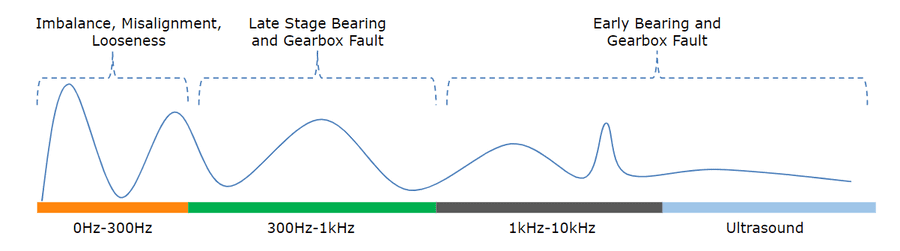
1. Vibration Displacement ($\mu\text{m}$): Low-Frequency Structural Issues ($< 10\text{ Hz}$)
Vibration displacement measures total mechanical clearance and shaft motion. It is ideal for low-speed rotating machinery such as large industrial fans, steam turbines, and high-power electric motors.
-
Key Use Case: Identifying structural defects such as rotor unbalance, shaft misalignment, and foundation looseness.
-
Measurement Method: Typically captured using non-contact eddy current proximity probes to directly monitor shaft movement and macroscopic deformation.
2. Vibration Velocity ($\text{mm/s}$): Overall Machine Severity ($10\text{ Hz} – 1000\text{ Hz}$)
Vibration velocity (often expressed as RMS value) is the standard metric used in ISO 10816 / ISO 20816 standards for machine vibration severity rating.
-
Key Use Case: Applied to general industrial equipment including centrifugal pumps, CNC machine tools, and air compressors.
-
Diagnostic Value: Reflects the total fatigue energy and overall operational degradation of the machine. It serves as the primary benchmark for daily inspections, routine maintenance, and operational health ratings due to its high consistency and reliability.
3. Vibration Acceleration ($g$ or $\text{m/s}^2$): Early High-Frequency Damage ($> 100\text{ Hz}$)
Vibration acceleration is highly sensitive to rapid, short-duration dynamic forces and micro-impacts.
-
Key Use Case: Essential for high-speed motorized spindles, gearboxes, and precision manufacturing equipment.
-
Diagnostic Value: Capable of detecting early-stage bearing spalling, gear mesh anomalies, and high-speed chatter long before displacement or velocity levels breach safety limits. It provides the crucial early warning required for true predictive maintenance.
Summary Matrix: Choosing the Right Parameter
| Metric | Unit | Frequency Range | Ideal Applications | Primary Fault Indicators |
| Displacement | $\mu\text{m}$ (p-p) | Low ($< 10\text{ Hz}$) | Turbines, Large Blowers, Motors | Unbalance, Misalignment, Looseness |
| Velocity | $\text{mm/s}$ (RMS) | Mid ($10 – 1000\text{ Hz}$) | Pumps, Compressors, CNC Tools | General Machine Wear, Structural Fatigue |
| Acceleration | $g$ or $\text{m/s}^2$ | High ($> 100\text{ Hz}$) | Gearboxes, High-Speed Spindles | Rolling Element Bearing Faults, Gear Impacts |
All-in-One Smart Condition Monitoring Solutions
现代智能边缘设备使多参数监测变得简单易行。例如,Sensen Tech 的集成监测解决方案将来自 IEPE 压电加速度计的原始信号采集与 IN-SDG 智能终端的边缘计算能力相结合。
通过在边缘硬件上直接运行实时数值积分算法,该终端可同时输出高精度的加速度、速度和位移指标。这种单硬件部署方案涵盖了全方位的故障诊断,使工厂能够实现智能预测性维护,降低停机成本,并延长资产使用寿命。
Post time: 2026-07-22