
In modern industrial automation, scientific research, smart home appliances, and healthcare, temperature sensors are indispensable tools. Among them, contact temperature sensors are widely recognized for their exceptional accuracy and long-term stability. By establishing direct physical contact with the target object, these devices deliver precise thermal data.
This comprehensive guide explores the core working principles, key technical classifications, pros and cons, and real-world applications of contact temperature sensors to help you optimize your thermal management systems.
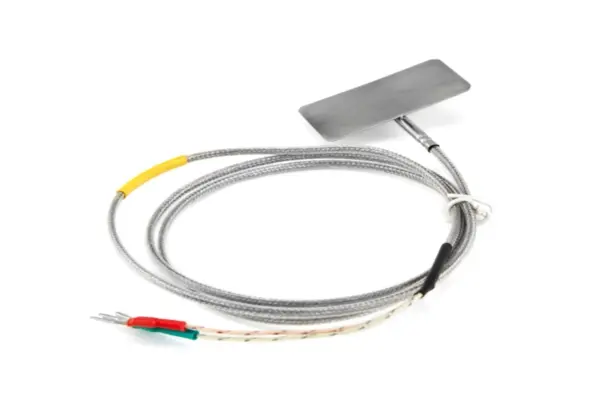
What is a Contact Temperature Sensor?
A contact temperature sensor is a device that measures temperature variations through direct physical contact with the medium under test (solids, liquids, or gases). These sensors typically consist of a temperature-sensing element, a protective outer casing (sheath or thermowell), and electrical connection terminals.
Unlike non-contact sensors (such as infrared pyrometers), contact sensors rely on thermal conduction to reach thermal equilibrium with the object being measured. The most common types include Thermocouples, RTDs (Resistance Temperature Detectors), and Thermistors. They are the preferred choice for applications requiring high precision, reliable data, and continuous long-term monitoring.
Core Working Principles of Contact Temperature Sensors
The operation of contact sensors relies on fundamental physical phenomena where material properties change alongside temperature. Here is how the three main types work:
1. Thermocouples
Thermocouples operate on the principle of the Seebeck Effect (the thermoelectric effect). When two dissimilar metallic conductors are joined to form a circuit, a temperature gradient between the measuring junction (hot junction) and the reference junction (冷端 / cold junction) generates a microvolt-level electromotive force (EMF).
-
Working Principle: A temperature difference across two distinct metals creates a voltage change proportional to that temperature delta.
-
Advantages: Extremely wide temperature ranges (up to 1800°C), robust construction, and fast thermal response times.
-
Disadvantages: Weak output voltage signals, lower relative precision, and the requirement for cold-junction compensation (CJC).
2. RTDs (Resistance Temperature Detectors)
RTDs track temperature by utilizing the predictable relationship between the electrical resistance of pure metals and temperature. As temperature increases, the metal’s resistance increases linearly. Platinum is the industry standard due to its excellent stability. The Pt100 is the most common variant, exhibiting a baseline resistance of $100\,\Omega$ at 0°C, increasing by roughly $0.385\,\Omega$ per 1°C rise.
-
Working Principle: Relies on the positive temperature coefficient of platinum wire or thin-film; temperature is computed by measuring precise resistance changes.
-
Advantages: Superior measurement accuracy, excellent linearity, and long-term stability.
-
Disadvantages: Limited temperature range (typically -200°C to +850°C), slower response times, and higher initial cost.
3. Thermistors (NTC/PTC)
Thermistors are ceramic or semiconductor-based resistors whose resistance changes drastically with temperature. They are split into two categories: NTC (Negative Temperature Coefficient), where resistance drops as temperature rises; and PTC (Positive Temperature Coefficient), where resistance increases with temperature. NTCs are highly popular for standard temperature-sensing duties.
-
Working Principle: Tracks exponential resistance drops (in NTCs) to calculate precise temperature values.
-
Advantages: Low cost, compact form factors, and exceptionally high sensitivity to small thermal changes.
-
Disadvantages: Narrow operating temperature range (typically -50°C to +300°C) and highly non-linear output curves.
Advantages and Disadvantages of Contact Sensors
Key Advantages:
-
High Measurement Accuracy: Contact sensors—especially platinum RTDs—deliver unmatched precision for critical process control.
-
Excellent Long-Term Stability: Direct physical coupling ensures consistent, highly repeatable data logging over extended operational periods.
-
Environmental Adaptability: Industrial probes can be customized with rugged materials (like 316L Stainless Steel or Hastelloy) to withstand high pressures, harsh chemicals, and moisture.
Inherent Disadvantages:
-
Mandatory Physical Contact: They cannot measure moving parts, objects under high voltage, or hazardous targets where physical touch is impossible.
-
Slower Thermal Response: Reaching thermal equilibrium takes time. Compared to instantaneous non-contact infrared sensors, contact sensors can lag during rapid thermal cycles.
-
Vulnerability to Environmental Interferences: Surface contaminants, scale buildup on sheaths, or poor thermal paste contact can degrade thermal transfer and skew readings.
Industrial and Commercial Applications
Contact temperature sensors are deployed across countless critical sectors:
-
Industrial Manufacturing: Used in automated process loops to manage boiler temperatures, kiln operations, and heavy machinery, ensuring safety and quality control.
-
Home Appliances: Integrated into consumer electronics like refrigerators, HVAC air conditioners, and water heaters for precise, safe thermostat regulation.
-
Healthcare & Medical Devices: High-precision NTC thermistors and RTDs power patient vital-sign monitors, medical incubators, and laboratory equipment.
-
Environmental Monitoring: Essential for weather stations, hydrological testing, and laboratory chambers to capture minute environmental ambient shifts.
Conclusion: Selecting the Right Sensor
Contact temperature sensors remain the backbone of thermal instrumentation due to their precision and reliability. Whether you select a rugged high-temperature thermocouple, a highly precise platinum RTD, or a cost-effective, hyper-sensitive thermistor depends entirely on your specific temperature envelope, accuracy targets, and budget limitations.
Post time: 2026-06-13