
No, not all K-type thermocouples are the same.
Although they are all called “K-type” (meaning they share the same nickel‑chromium / nickel‑silicon alloy material system), in real‑world applications they differ greatly in accuracy class, sheath structure, material details, application environment, and calibration standards.
Simply put:
“K-type” only defines the thermoelectric material — NOT the full product specification.
Below is a detailed explanation of the differences:
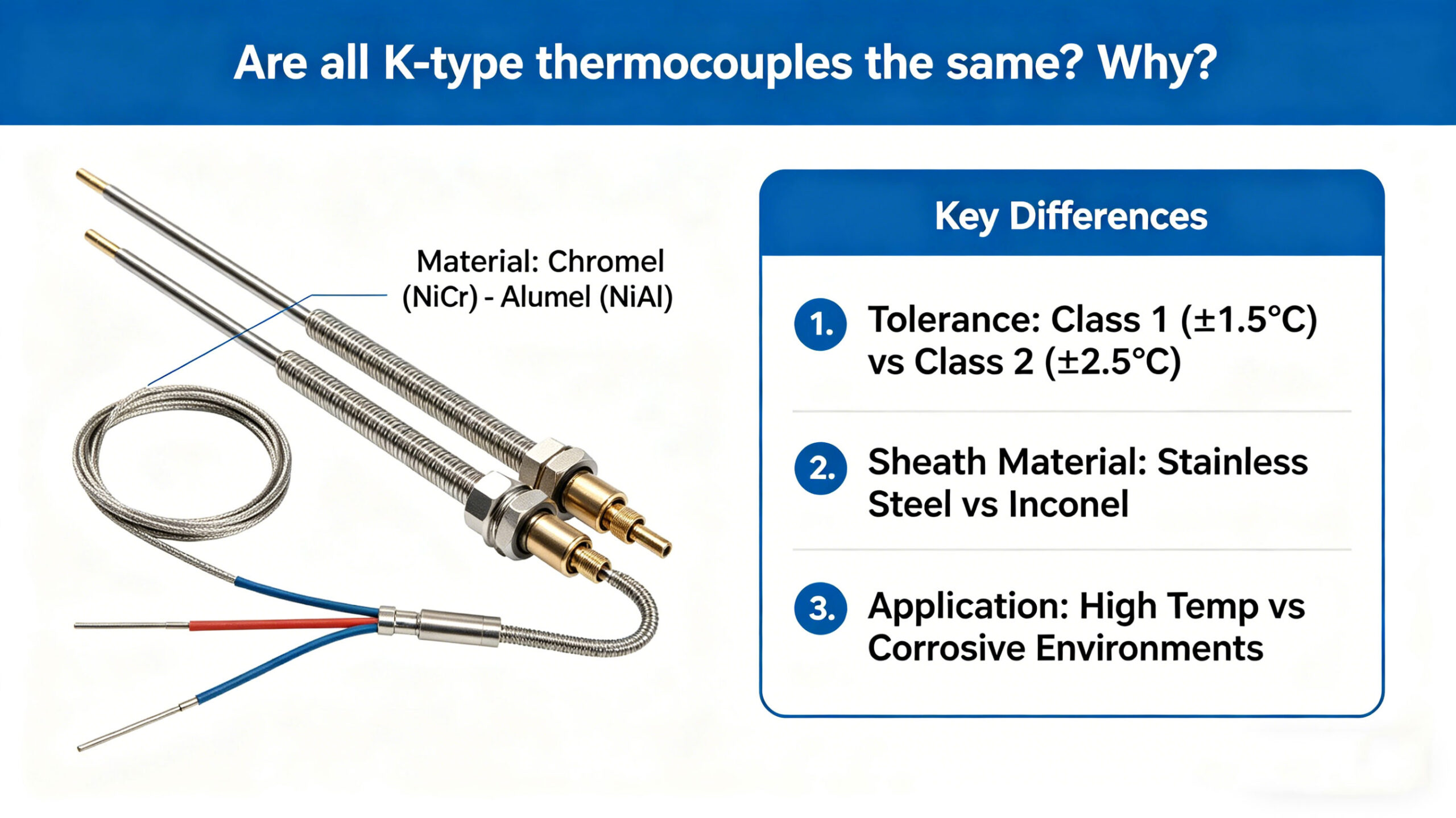
1. Different Accuracy Classes (The Most Critical Difference)
Under IEC and Chinese national standards (GB), K-type thermocouples are strictly divided into two accuracy classes. They are not interchangeable.
表格
| Item | K-Type Class 1 (Precision) | K-Type Class 2 (General) | ||||
|---|---|---|---|---|---|---|
| Application | Laboratories, precision metering, critical process control | Industrial sites, general temperature measurement, harsh environments | ||||
| Tolerance | ±1.5 ℃ or ±0.004 | t | ℃ (whichever is larger) | ±2.5 ℃ or ±0.0075 | t | ℃ (whichever is larger) |
| Material Control | Extremely strict chemical composition, very low impurities | Looser control, meets basic thermoelectric requirements | ||||
| Price | Higher | Lower |
2. Different Structures & Sheaths (For Different Environments)
Bare K-type thermoelements are fragile and must be packaged, resulting in completely different performance:
-
Bare Wire
Only the thermoelements, no protection tube.
Used in vacuum furnaces, high-temperature labs, or as semi-finished products.
Weakness: easily oxidized, broken, cannot touch corrosive liquids.
-
Grounded Sheath
Wires contact and weld to the inner sheath.
Used for fast-response industrial measurement.
Weakness: may short or interfere if the medium is conductive.
-
Insulated Sheath
Wires isolated with compressed MgO insulation.
Used in EMI, humid, or electrically charged environments.
-
Wear‑Resistant / Corrosion‑Resistant Type
Uses special sheaths (316L, Hastelloy, ceramic).
Used for molten metal, strong acids, alkalis, or high‑abrasion gas.
3. Different Diameters & Lengths
Diameters range from 0.5 mm (micro) to 3 mm or thicker.
Lengths range from a few centimeters to several meters.
- Micro-armored K-type: Fine as hair, used in narrow tubes, engine interiors.
- Large assembled K-type: Heavy and rugged, used in chemical plant furnaces.
4. Matching of Compensating Cables & Instruments
K-type outputs millivolt-level signals and requires correct accessories:
- Compensation cables: Must use K-type extension/compensation cables (usually red/black). Do NOT use J-type or E-type — huge errors will occur.
- Cold‑junction compensation: Instruments use K-type polynomial / tables. Using other thermocouple types gives completely wrong values.
5. Consistency & Aging
- Consistency: Even Class 2 units are calibrated individually. Although within tolerance, their actual thermoelectric curves are not perfectly identical.
- Aging: At high temperatures, oxidation and grain growth cause drift. Higher‑grade K-types resist drift better and last longer.
Summary
K-type only defines one temperature‑to‑voltage conversion relationship.
- For precision experiments: use Class 1 with calibration certificate.
- For furnace monitoring: use Class 2 armored type.
- For acid/alkali liquids: use corrosion‑resistant sheath.
Otherwise you will get inaccurate data, damage instruments, or even cause safety risks.
Post time: 2026-04-02